Robotics / AI & ML
ABYSS AI
Adaptive Biodiversity Exploration
Intelligence for underwater exploration.
- Role
- Co-founder. Simulator, mission integration and Mission Control.
- Status
- Research prototype and early-stage initiative
- Year
- 2026
- Team
- Built with Cam and Ammar. First version made in 24 hours at WHACK 2026 for the Marshall Wace New Worlds Challenge.
01
The problem
Most of the deep ocean has never been surveyed, and underwater robots run on a fixed battery. Most surveys follow a route planned before the dive, like mowing a lawn, and ignore what the robot finds on the way.
ABYSS asks a narrower question: if a robot updates its beliefs after every survey and replans, does it find more life on the same energy budget, and can it still always get home?
02
My contribution
I built the simulation backbone: the 900-waypoint GEBCO Monterey Canyon environment, the hidden biodiversity worlds, the energy and safe-return rules (SciPy Dijkstra over the seabed graph), deterministic runs and logging, and the mission contract that planners talk to. I also built Mission Control, the interactive Three.js replay.
The Bayesian learner, planner, baselines and benchmark statistics were built by Cam. The computer-vision pipeline and findings report were Ammar's. The project has continued as an early-stage initiative since the hackathon.
- Python
- Three.js
- Bayesian planning
- Computer vision
- GEBCO bathymetry
03
How it works
Observe
Survey a spot. A vision model (DINOv2 on FathomNet photos) names the kinds of life in the images.
Learn
A Bayesian regression links how many kinds were found to the terrain there, such as depth, slope and ridge or valley, and tracks how sure it is.
Plan
Score every safe, unvisited spot by predicted life plus learning value plus new ground, divided by energy cost.
Explore
Travel to the best spot and survey it. The simulator only reveals what the camera would actually see.
Return safely
A target is accepted only if the remaining energy covers travel, the survey, the trip home and a reserve.
04
Engineering details
Planners never see the answer
Hidden biodiversity lives in separate reveal files. Planners only receive the public map, their own state and what the camera saw, and tests check that nothing leaks.
Safe return as an invariant
Every target must satisfy remaining energy >= travel + survey + return + reserve. Costs are symmetric, so the cost home from any cell is a single Dijkstra run from home.
Fair, deterministic comparison
Each world is generated once per seed, independent of the planner. Terrain, world and planner use separate random streams, and settings were tuned on practice oceans and frozen before the held-out run.
Real seafloor, simulated life
The bathymetry is a 30 by 30 crop of the GEBCO 2025 grid over Monterey Canyon and the photos are real. Where organisms live is simulated, so every robot can be scored against a known answer.
Mission Control
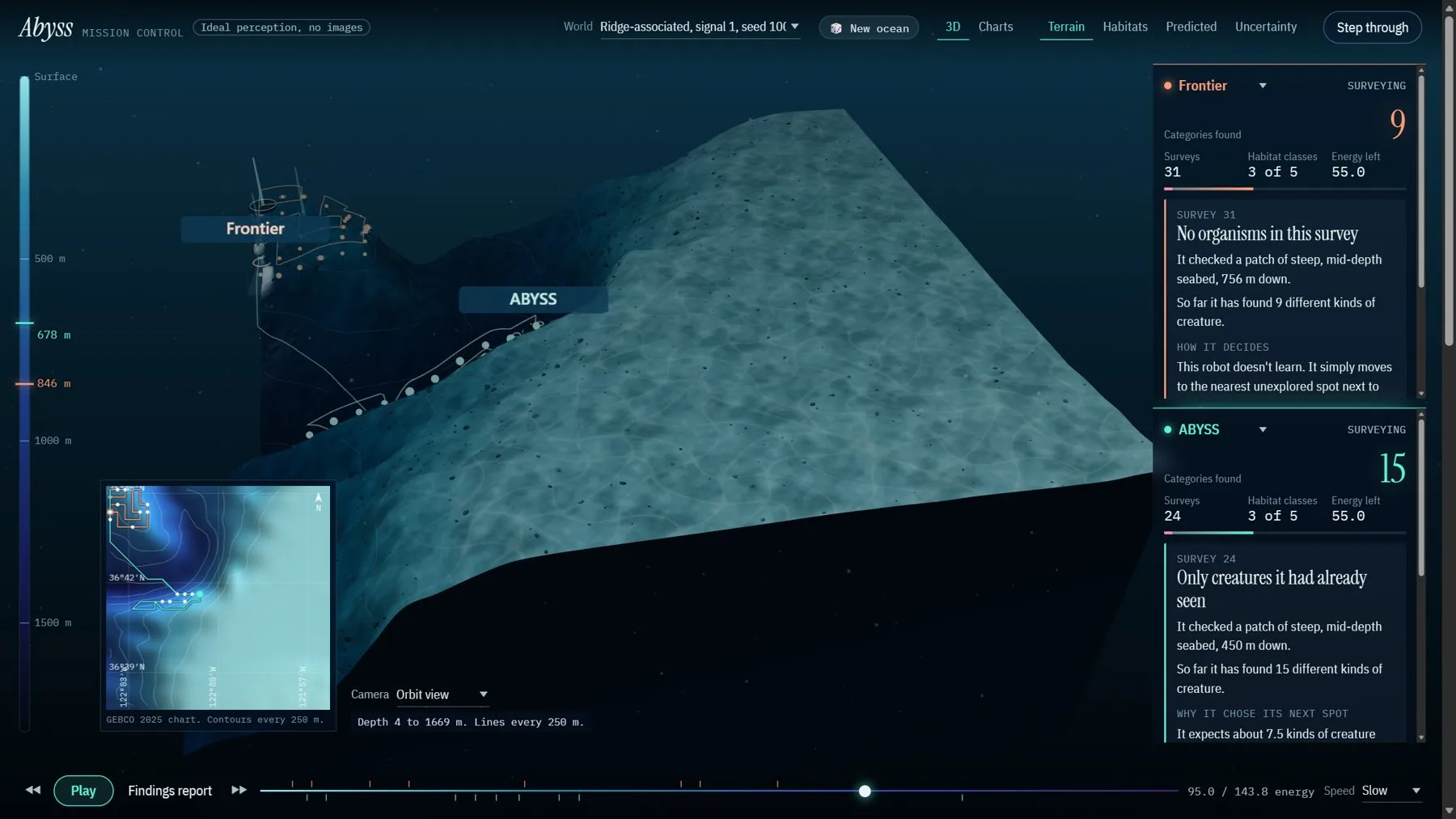
A Three.js replay of logged missions with terrain, habitat, predicted and uncertainty layers, charts and side-by-side robots. It runs in any browser, offline, with no downloads.
05
Results & limitations
Where life follows terrain, learning where to look pays off: ABYSS found about 42% more kinds of life than frontier exploration on the same battery. The gain shrinks as the link between terrain and life weakens, and it does not win everywhere.
6,300
simulated benchmark missions
50 held-out oceans, every planner on the same worlds. All returned safely, with 0 forced returns.
15.8 vs 11.1
kinds of life found, out of 16
ABYSS vs frontier exploration where life follows ridges. About 42% more (+4.7, 95% interval +4.3 to +5.1).
3.3 fewer
with learning switched off
Same robot, same ridge worlds. The gain comes from the learning, not the route.
Limitations and honest caveats
- It is a simulation. The seafloor and photos are real, but where organisms live is simulated so every robot can be scored against a known answer. Energy is in abstract units.
- It does not win universally. A simple lawnmower sweep beats it where life favours flat ground, because ABYSS predicts how much life a spot has, not whether it is new.
- The benchmark covers one canyon, a 30 by 30 grid and five simulated world types.
- No physical robot has been built or deployed. ABYSS AI is an early-stage initiative, not a product.
06
Gallery
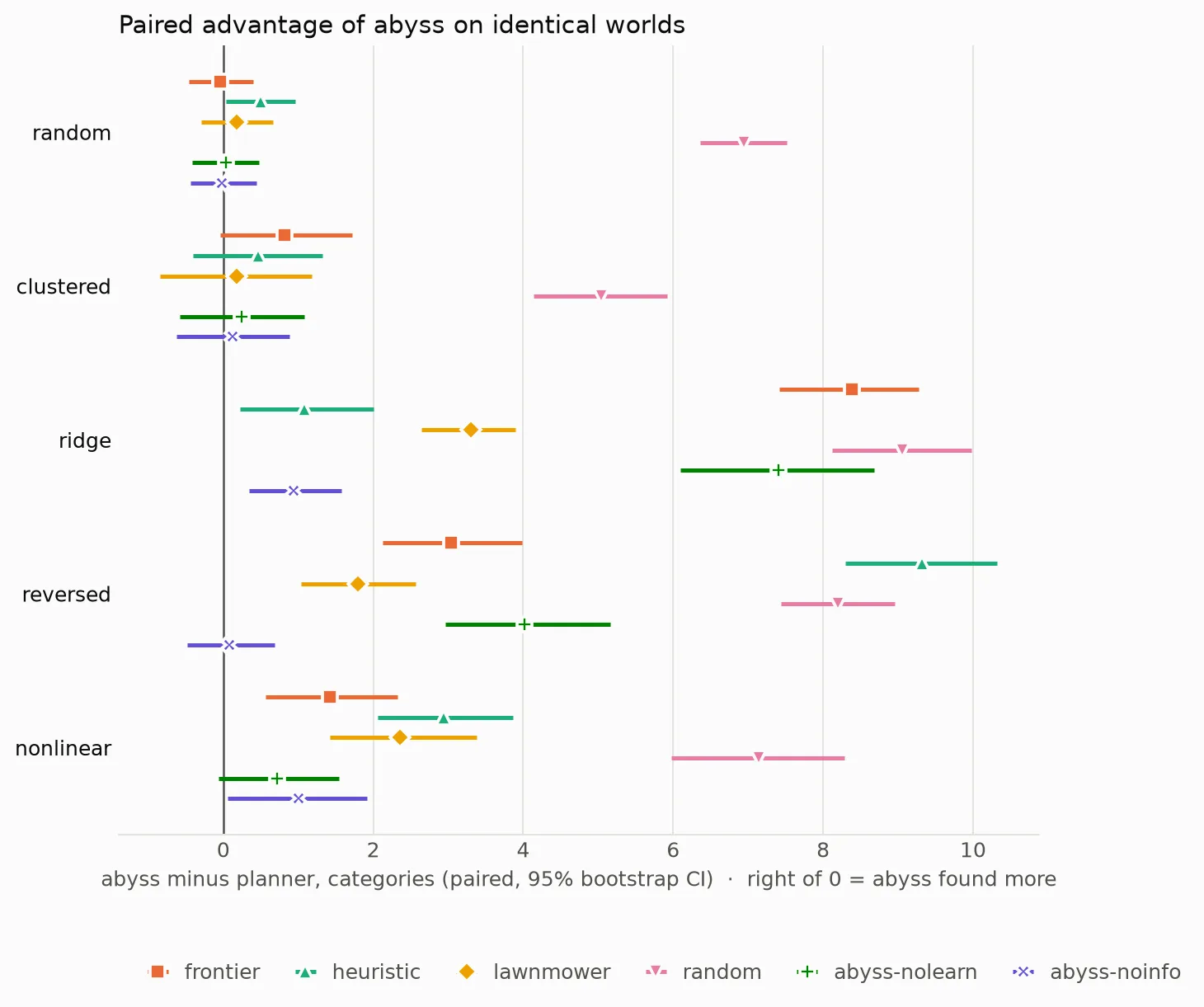
Paired advantage of ABYSS over each baseline on identical worlds, with 95% bootstrap intervals. Right of zero means ABYSS found more. The rows near zero are the worlds where it does not win.